
Hey there,
Maybe you’ve read a hundred “mindset shift” posts by now. Think positive. Manifest your goals. Rewire your brain. It’s everywhere, and some of it is genuinely useful. But if you’re a woman of faith, you’ve probably felt the gap between that advice and what you actually believe. Positive thinking can’t carry the weight of a hard diagnosis, a strained marriage, or a 3 a.m. worry about your kids. Something deeper can.
That’s where a Christ-centered mindset comes in. It’s not about forcing happy thoughts. It’s about anchoring your thinking in something outside yourself, something steady enough to hold you through your 20s, your 30s, and your 40s, whatever those decades bring.
What Does “Christ-Centered Mindset” Actually Mean?
A Christ-centered mindset is the practice of filtering your thoughts, decisions, and self-talk through your identity in Christ rather than through culture, comparison, or your own fear. It’s less about controlling every thought that pops into your head and more about which voice you listen to when those thoughts show up.
Scripture describes this as a process of transformation, not a one-time decision. Your mind is renewed over time, through practice, prayer, and truth, the same way a muscle grows through repeated use. This is a slow, steady rebuilding, not an overnight fix, and that’s actually good news. It means you don’t need to have it all figured out today.
Christ-Centered Mindset vs. Growth Mindset vs. Fixed Mindset
You’ve likely heard the terms “growth mindset” and “fixed mindset” before, especially if you’ve read anything about parenting or personal development. Understanding the difference helps clarify what makes a Christ-centered mindset distinct.
A fixed mindset is the belief that your abilities, intelligence, and character are mostly set in stone. You either have what it takes, or you don’t. This mindset tends to avoid challenges, because failure feels like proof of a fixed limitation.
A growth mindset, a concept developed by psychologist Carol Dweck, is the belief that abilities and character can be developed through effort, strategy, and persistence. It’s a helpful shift for many people, and it has real psychological research behind it. But on its own, a growth mindset still places the weight of change entirely on you. Your effort. Your strategy. Your grit.
A Christ-centered mindset borrows the best part of a growth mindset, the belief that you’re not stuck, and adds something a purely psychological model can’t offer: your growth isn’t dependent on your own strength alone. God is shaping you, not just by willpower. Your worth isn’t earned through progress. It’s already settled in Christ, which actually frees you to grow without the constant pressure of proving yourself.
This distinction matters. A growth mindset says, “You can change if you work hard enough.” A Christ-centered mindset says, “You are already loved and secure, and from that security, real change becomes possible.” One is performance-based. The other is grace-based.
Why This Matters More in Your 25s, 30s, and 40s
Mindset conversations often focus on teenagers or young professionals, but the truth is, your identity is tested more in this season of life than in almost any other. You’re navigating career shifts, marriage, motherhood, or the ache of waiting for it, aging parents, changing friendships, and a body and schedule that rarely feel like your own anymore.
Social media adds a constant, quiet pressure to compare: her clean house, her thriving business, her calm parenting, her marriage that looks effortless from the outside. Without a steady internal anchor, it’s easy to absorb all of that as evidence that you’re behind. A Christ-centered mindset doesn’t erase the comparison culture around you, but it gives you a place to stand that doesn’t move when everyone else’s highlight reel does.
The 4 Pillars of a Christ-Centered Mindset
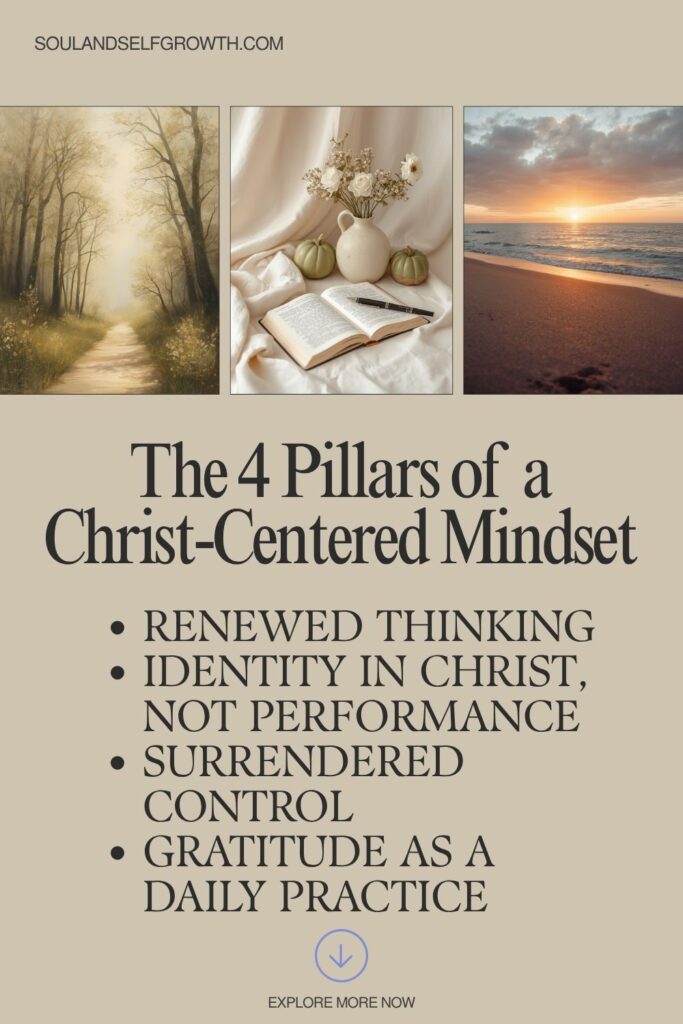
These four pillars give you a practical framework, something to come back to when old thought patterns creep in.
Renewed Thinking
“Don’t be conformed to this world, but be transformed by the renewing of your mind, so that you may prove what is the good, well-pleasing, and perfect will of God.” (Romans 12:2, WEB)
Renewed thinking means noticing the thought patterns you’ve absorbed from culture, from your upbringing, from years of comparison, and actively replacing them with truth. It’s not about ignoring hard feelings. It’s about not letting culture have the final word on how you see yourself.
Identity in Christ, Not Performance
“For we are his workmanship, created in Christ Jesus for good works, which God prepared beforehand, that we should walk in them.” (Ephesians 2:10, WEB)
Your worth was decided before you accomplished a single thing. Not after the promotion. Not after the clean house or the well-behaved kids or the successful launch. This pillar is the one most women need to hear most often, especially in a season where your value can start to feel tied to your output.
Surrendered Control
“Trust in Yahweh with all your heart, and don’t lean on your own understanding. In all your ways acknowledge him, and he will direct your paths.” (Proverbs 3:5-6, WEB)
A Christ-centered mindset doesn’t mean you stop planning or stop making decisions. It means you hold those plans with open hands, trusting that you’re not the only one steering. This is often the hardest pillar for women who are used to being the one who holds everything together.
Gratitude as a Daily Practice
“In nothing be anxious; but in everything by prayer and supplication with thanksgiving let your requests be made known unto God.” (Philippians 4:6, WEB)
Gratitude isn’t a bypass for hard emotions. It’s a practice that trains your attention toward what’s true and good, even in a genuinely difficult season. Over time, this pillar reshapes anxious thought patterns more than almost any other single practice.
Common Thought Patterns That Block a Christ-Centered Mindset
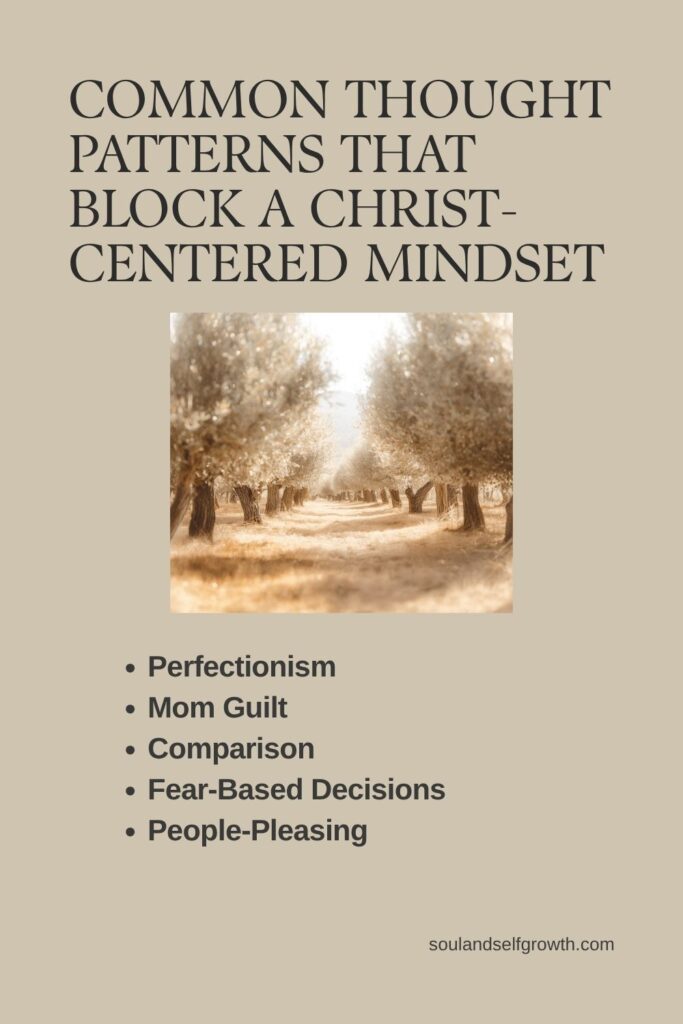
Before you can build something new, it helps to recognize what’s already running in the background. These patterns are common, and none of them make you a failure. They just point to where the renewing needs to happen.
- Perfectionism. The belief that you have to get everything right before you’re allowed to feel at peace or worthy of rest.
- Mom guilt. Measuring your worth as a mother against an impossible, ever-shifting standard, usually one you didn’t even choose for yourself.
- Comparison, especially online. Scrolling through curated snapshots of other women’s lives and quietly concluding you’re behind.
- Fear-based decision-making. Choosing the safest option out of anxiety rather than out of genuine conviction or peace.
- People-pleasing. Basing your sense of self on whether others approve of you in any given moment.
You don’t need to fix all five at once. Naming even one of these patterns honestly is often the first real step toward change.
A Simple Daily Practice to Build a Christ-Centered Mindset This Week
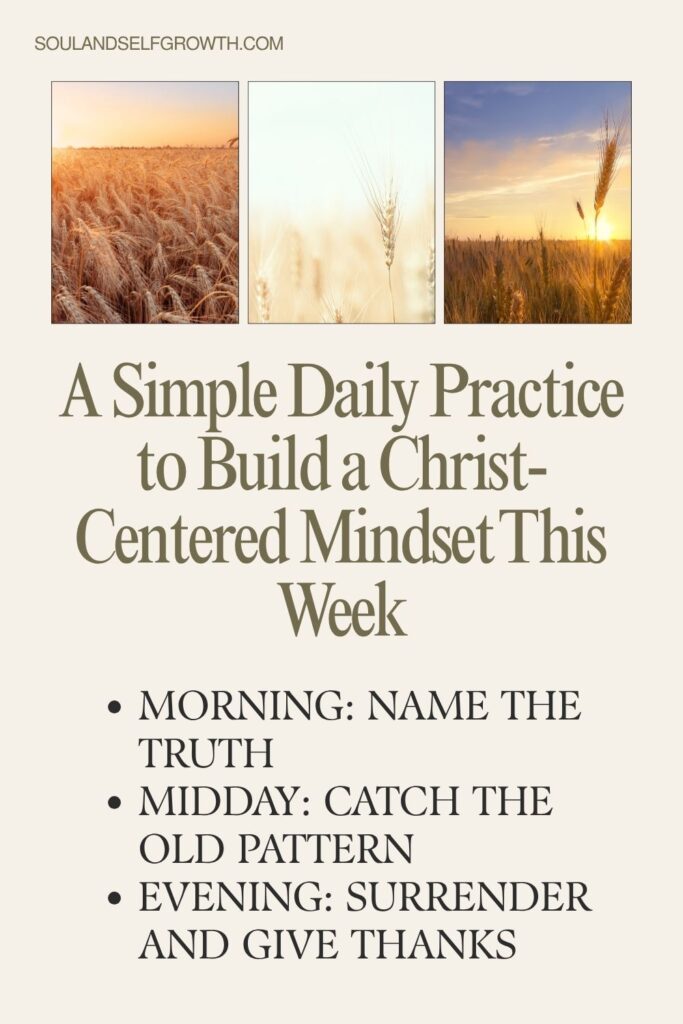
Here’s a short, repeatable practice you can start today. It takes less than ten minutes and fits around a full schedule.
- Morning: Name the truth. Before you check your phone, say one true thing about your identity in Christ out loud. Something as simple as “I am God’s workmanship” is enough.
- Midday: Catch the old pattern. When you notice comparison, anxiety, or perfectionism creeping in, pause and name it. “This is fear talking” or “this is comparison” takes away some of its power.
- Evening: Surrender and give thanks. Before bed, hand over one thing you tried to control today, and name one thing you’re grateful for. Do this even on hard days, especially on hard days.
Repeat this for a week and notice what shifts. Mindset change isn’t instant, but it is real, and it compounds faster than most people expect.
If you enjoyed this, you might also like our posts on
Easy Christian Routine For Women: Start And End Your Day With God | Soul And Self Growth,
How to Get Closer to God – A Christian Daily Routine to Bring God’s Word | Soul And Self Growth
which pairs well with this kind of mindset work.
Are you looking for more lifestyle tips? Feel free to explore my Pinterest page as well!
Quick Recap
A Christ-centered mindset isn’t the same as a growth mindset with a Bible verse attached to it. It’s a different foundation altogether: renewed thinking, an identity rooted in Christ rather than performance, surrendered control, and daily gratitude. Recognizing the thought patterns that block this- perfectionism, mom guilt, comparison, fear, people-pleasing- is the starting point. From there, a short daily practice of naming truth, catching old patterns, and surrendering with gratitude can genuinely reshape how you think over time.
You weren’t made to think your way into worthiness. You already have it. Every renewed thought is just you stepping further into what’s already true.

0 Comments