
Hey there,
If you have ever opened the Bible, stared at the first page, and quietly closed it again. You are not alone.
I have been there too. As a busy mom, my days are full before they even really begin. There is lunch to pack, a little one to chase, and a never-ending to-do list that somehow gets longer every night. Finding time to sit down and read the Bible felt impossible. And even when I did find a quiet moment, I did not know where to start or what I was supposed to get out of it.
But something shifted for me when I stopped treating the Bible like a textbook I had to study and started treating it like a conversation I was invited into. Now, even on the hardest days, opening my Bible is one of the things I genuinely look forward to. It grounds me. It reminds me who I am and whose I am.
If you are a beginner who wants to start reading the Bible but feels overwhelmed, this guide is for you. I will walk you through everything, simply and practically. No theology degree required.
This site contains affiliate links. I may earn a small commission, at no extra cost to you. I’d appreciate it if you can support me.
Why Read the Bible at All?
Let’s start here, because this matters.
Reading the Bible is not about checking a box or being a “good Christian.” It is about building a real relationship with God. And like any relationship, it grows through consistent, honest communication.
When life feels chaotic or unclear, the Bible gives you a place to find direction. When you feel lonely or misunderstood, it reminds you that you are deeply known and loved. When you feel anxious, it speaks peace into the noise.
As Psalm 119:105 says: “Your word is a lamp to my feet, and a light for my path.” (WEB)
That is what the Bible does for everyday life. It does not remove the hard things. It lights the next step so you can keep going.
You do not need to understand everything to benefit from it. You just need to show up.

Where Should a Beginner Start?
This is the question most beginners never think to ask. They open to Genesis, read through creation, and then hit Leviticus with all its laws and lists. And they stop.
That is completely normal. Leviticus is not the best starting point for a beginner.
Here are three places that work much better:
The Gospel of John. This is the best place to start if you want to know who Jesus is. John writes in a warm, personal way. You will feel like he is talking directly to you. Start here if faith and relationship with Jesus are what you are after.
The Book of Psalms. These are poems and prayers written by real people going through real things. Fear, grief, joy, confusion, gratitude. If you want to feel emotionally connected to Scripture, the Psalms meets you exactly where you are.
The Book of Proverbs. Short, practical, and full of everyday wisdom. Each chapter is easy to read in just a few minutes. If you want daily guidance for decisions, relationships, and how to live well, start here.
Pick one. Start there. You do not need to read the whole Bible before it starts to mean something.
How to Actually Read It: The R.E.A.D. Method
Here is the method I recommend for beginners. It is simple, clear, and takes less than 15 minutes a day.
I call it the R.E.A.D. method.
R. Read a short passage. Pick 5 to 10 verses. That is it. You do not need to read a full chapter every day. Small and consistent will always beat long and burnt out.
E. Examine what it says. Ask yourself: What is actually happening here? Who is speaking? Who are they talking to? What is the main point of this passage? You are not analyzing it like a literature class. You are just paying attention.
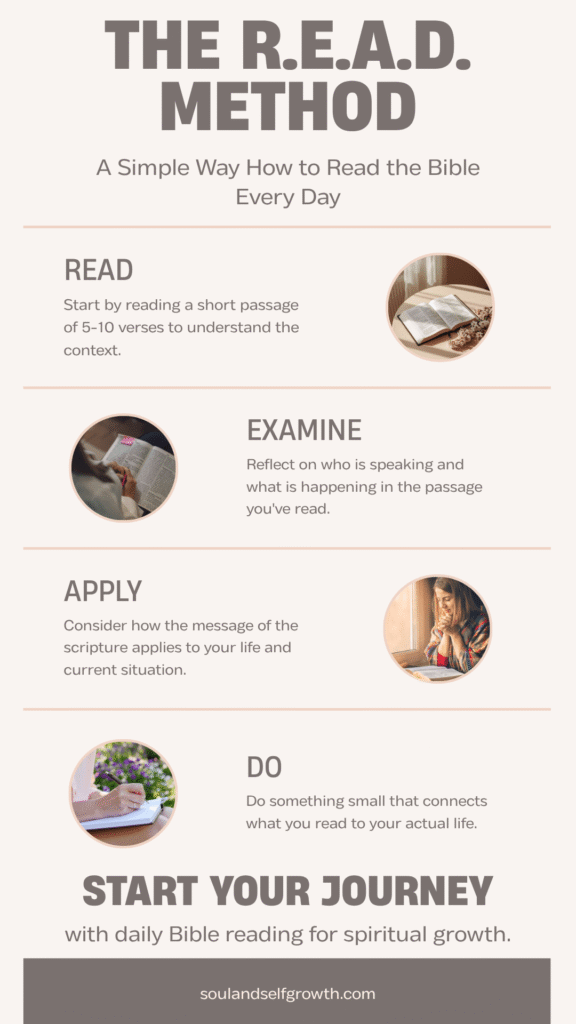
A. Apply it. This is the key step. Ask yourself: What does this mean for my life today? Is there something here I need to believe, do, or let go of? This is where the Bible goes from words on a page to something real.
D. Do something with it. Write one sentence in a journal. Pray about what you read. Share a verse with a friend. Do something small that connects what you read to your actual life. This step is what makes it stick.
That is the whole method. Four steps. You can do it over your morning coffee, during nap time, or right before bed.
Tools That Actually Help
You do not need to spend money to read the Bible well. Here are a few free and simple tools:
The YouVersion Bible App. It is free, easy to use, and has dozens of translations available. It also has beginner-friendly reading plans if you want more structure. You can even listen to it if reading feels hard some days.
BibleGateway.com. A free website where you can search any verse, read different translations side by side, and find basic context for passages.
A simple notebook. Nothing fancy. Just a place to write down what stands out to you. Writing helps you remember and process what you read.
A highlighter. If you use a physical Bible, highlight verses that speak to you. Your Bible should look used. That is a good thing.
That is all you need to get started.
What to Do When You Don’t Understand Something
This will happen. A lot. And it is completely okay.
The Bible was written thousands of years ago, in different languages and cultures. Some parts are easy to understand. Others take more context.
Here is what to do when you feel lost:
Pray before you read. Ask God to help you understand what you are reading. James 1:5 says: “But if any of you lacks wisdom, let him ask of God, who gives to all liberally and without reproach, and it will be given to him.” (WEB) That promise applies to Bible reading, too.
Look up the context. Use BibleGateway.com to find a short introduction to the book you are reading. Knowing who wrote it and why makes a big difference.
Try a different translation. Sometimes reading the same passage in a simpler translation like the New Living Translation (NLT) makes it click.
Do not let confusion stop you. Keep reading. Understanding grows over time.
How to Build the Habit (Especially as a Busy Mom)
Here is the truth: you will not always feel motivated. Some days you will skip it. That is okay.
But here is what actually works for building the habit:
Start with 5 minutes, not 30. Five minutes every day is more powerful than 30 minutes once a week. Start small and let it grow naturally.

Attach it to something you already do. Read your Bible while you drink your morning coffee. Open your app during your lunch break. Read a Psalm before you go to sleep. Link it to an existing routine, and it becomes part of your day without much effort.
Drop the guilt when you miss a day. One missed day does not mean you failed. Just start again tomorrow. Grace applies here, too.
Progress is not about how much you read. It is about showing up consistently over time.
You Are Ready to Start
You do not need to have everything figured out before you open your Bible. You do not need the perfect quiet time routine or the right journal or years of church experience.
You just need to start. One passage. One question. One honest prayer.
God meets you exactly where you are. Every time you open your Bible, you are taking a step toward knowing Him better. That is enough.
Do you want to go deeper? Read
How to Make a Vision Board That Goes Deeper – Healing Vision Board Guide | Soul And Self Growth
30 Prayer Journal Prompts (Even If You Have Little Time) | Soul And Self Growth
If you’re looking for more lifestyle tips, feel free to explore my Pinterest page as well!
Want a Simple Place to Start?
I created a free 7-Day Bible Journal just for women who are ready to start reading the Bible but are not sure where to begin.
Each day gives you a short passage to read, a few simple questions to reflect on, and space to write down what God is showing you. No experience needed. Just an open heart and 10 minutes a day.
Sign up in the box on this page to get instant access. It is completely free.
The Bible verses in this post are quoted from the World English Bible (WEB), which is in the public domain.
0 Comments